Shopify Jewelry Store Product Pages: 7 Fixes That Turn Browsers Into Buyers
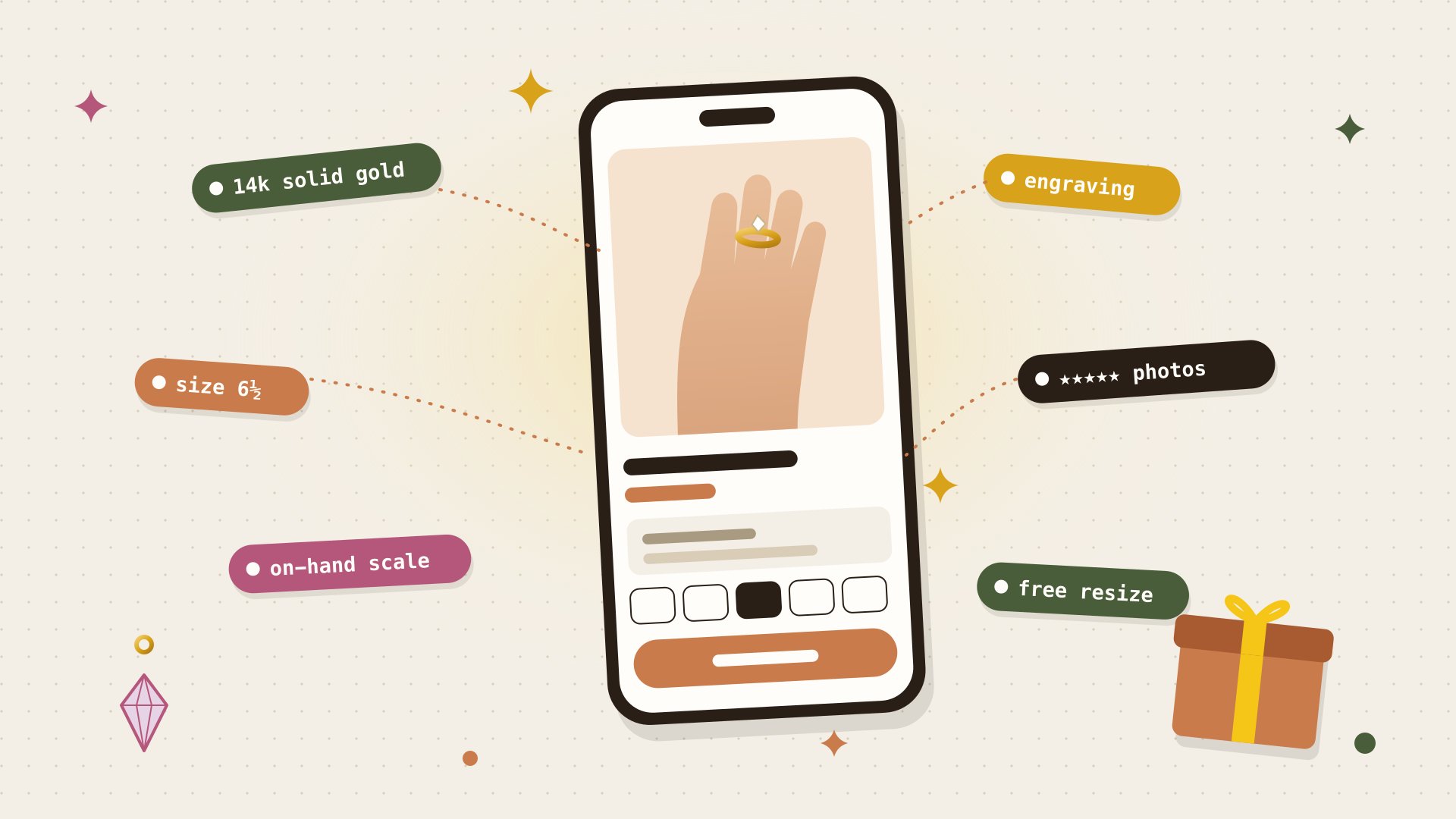
Jewelry shoppers need scale, metal spec, sizing, gifting and trust answered before they buy. Seven product page fixes for Shopify jewelry stores, with a PDP self-check.
A Clutch Verified Shopify agency
Rated 5.0 out of 5 stars by our clients
A shopper finds a pendant on your store on Tuesday night. She zooms into the photos, scrolls to the bottom, closes the tab. On Thursday she’s back from an Instagram story, checks the price again and opens the reviews. On Sunday she comes back a third time, looks for the chain length, can’t find it, and buys a similar one somewhere else.
Nothing was wrong with the pendant. The product page just never answered the question she came back to ask. That’s the pattern we see on almost every Shopify jewelry store we audit, from small studios to brands on Shopify Plus, and it’s fixable without a redesign.
Here are the seven product page fixes we make most often, with a self-check at the end so you can score your own page.
Why Shopify jewelry stores lose buyers on the product page
Jewelry is a considered purchase. The piece is small, often expensive, often a gift, and the buyer can’t hold it. So instead of deciding on the first visit, she collects answers over several. Every visit that ends without an answer is a chance for a competitor’s page to give it first.
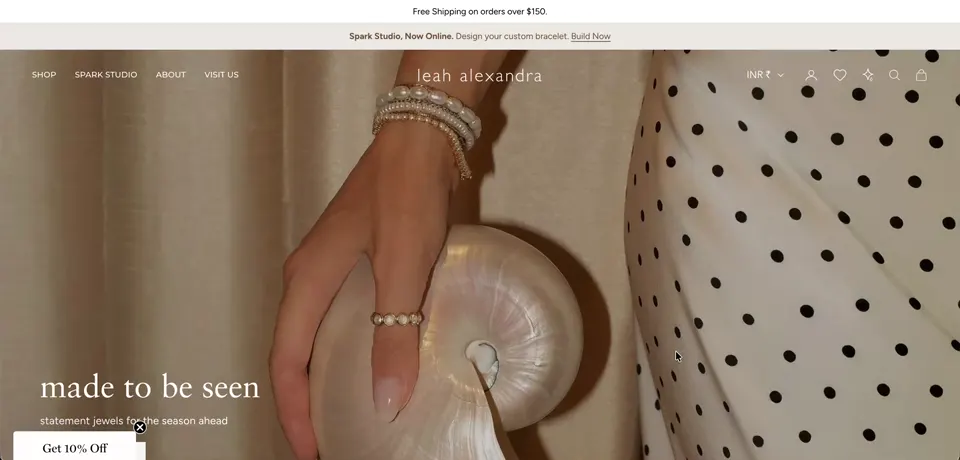
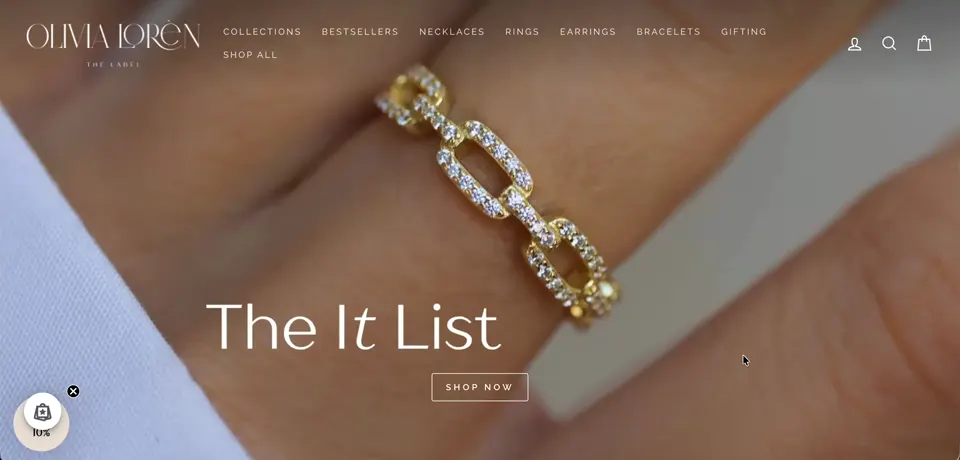
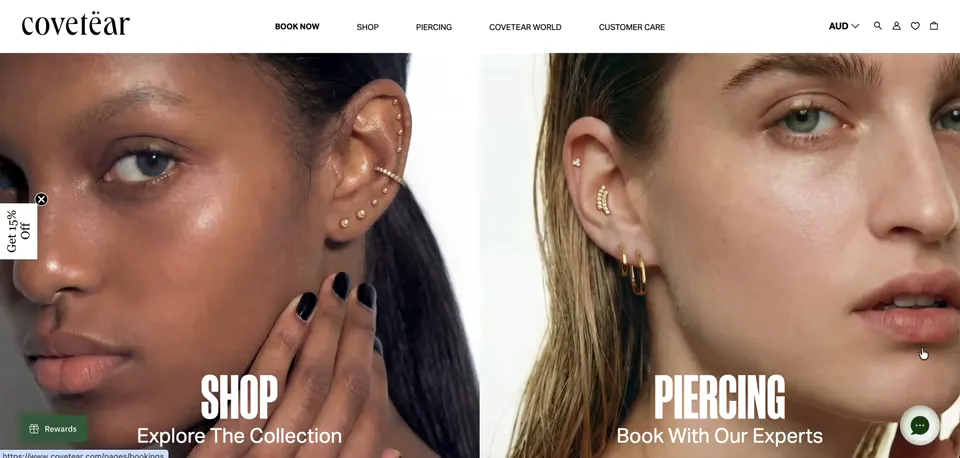
The questions are remarkably consistent across the jewelry stores we’ve worked on, including Leah Alexandra, Olivia Lorèn and Covetear:
- How big is it, really, when it’s on me?
- What exactly is it made of, and will it tarnish or irritate my skin?
- Will it fit?
- Can I personalise it, and what will that cost in total?
- Will it arrive looking like a gift?
- Can I trust this brand with this much money?
- What happens if it’s wrong?
A theme’s default product template answers almost none of these. It gives you a gallery, a title, a price, a variant picker and a description box. The fixes below fill the gaps.
1. Show real scale, not just a pretty angle
Jewelry photography on a white background is beautiful and almost useless for judging size. A 6 mm stud and a 12 mm stud look identical when each one fills the frame.
What works:
- At least one on-body photo per product. A ring on a hand, an earring on an ear, a necklace on a neck with the collarbone in shot. If you can only afford one extra photo per product, make it this one.
- Dimensions in millimetres, near the price. Pendant height, stone size, band width, hoop diameter. Shoppers compare these across stores, so give them a number to compare.
- A chain length guide. A simple neck diagram showing where 16 in (40 cm), 18 in (45 cm), 20 in (50 cm) and 24 in (60 cm) chains sit answers the single most common necklace question.
- Short video. A few seconds of the piece turning in natural light shows sparkle and movement that stills can’t. Keep it muted, looped and lazy-loaded.
Heavy imagery is also where jewelry stores get slow. Serve images through Shopify’s CDN at the size they’re displayed, lazy-load everything below the first image, and keep video off the first screen on mobile. Our Shopify speed playbook covers the image and app culprits in detail.
If you want to go further than photos, AI try-on has the clearest payoff in jewelry and eyewear, because scale is exactly what static images undersell. We wrote up how we build it, and where it goes wrong, in our virtual try-on build guide.
2. Put the material spec above the fold
“Gold” is not a spec. A shopper comparing your $180 gold ring against someone else’s $95 gold ring needs to know why one costs twice as much, and the answer is usually in the metal.
Put a short, scannable spec block right under the price, not three tabs down: metal and purity, finish, stone and its origin, dimensions, and weight where it matters. Then explain the terms buyers confuse. These are the US definitions under the FTC’s Jewelry Guides, and they’re worth getting right:
| Term on the page | What it means | What buyers want to know |
|---|---|---|
| Solid gold (10k, 14k, 18k) | Gold alloy all the way through. 10k is 41.7% gold, 14k is 58.3%, 18k is 75% | Won’t wear through, can be resized and repaired |
| Gold vermeil | Sterling silver coated with at least 10k gold, at least 2.5 microns thick | Thicker than plating, but the coating can wear with daily use |
| Gold filled | A layer of at least 10k gold bonded to a base metal, at least 1/20 of the metal’s weight | Durable for the price, not the same as solid |
| Gold plated | A thin gold layer over another metal | Most affordable, will wear through over time |
| Sterling silver (925) | 92.5% silver | Can tarnish, care instructions matter |
| Lab-grown diamond | A real diamond made in a lab. The FTC requires a clear qualifier such as “laboratory-grown” | Same look and hardness, lower price, origin must be stated |
Two more lines earn their place in the spec block: nickel-free or hypoallergenic, if it’s true, because skin reaction is a top worry for earring buyers, and care instructions, written as one or two plain sentences rather than a PDF.
Keep these values in metafields rather than typed into each description. That way the spec block renders the same way on every product, you can filter collections by metal and stone, and AI shopping assistants can read the facts cleanly. Our guide to product schema for AI search explains why structured specs get your products cited.
3. Solve ring sizing before it becomes a return
Ring size is the moment jewelry buyers leave to search for “how to measure ring size” and don’t come back. Keep them on the page.
- Put the size guide inline, right beside the size selector, as an expandable panel rather than a pop-up that covers the product.
- List US, UK and EU sizes with the inner diameter in millimetres. International buyers think in different systems, and millimetres are the one measurement everyone can check with a ring they already own.
- Explain the two reliable ways to measure: measure the inside of a ring that already fits, or visit any local jeweller. Skip the paper-strip method, which is the least accurate and causes the most exchanges.
- Offer half sizes if you make them, and say which pieces can’t be resized, such as eternity bands.
- Remove the risk. A free ring sizer mailed on request, or a free first resize, turns “I’m not sure of my size” from a reason to wait into a reason to order.
| US | UK | EU (circumference) | Inner diameter |
|---|---|---|---|
| 5 | J½ | 49 | 15.7 mm |
| 6 | L½ | 52 | 16.5 mm |
| 7 | N½ | 54 | 17.3 mm |
| 8 | P½ | 57 | 18.1 mm |
| 9 | R½ | 59.5 | 19.0 mm |
A table like this, right beside the size buttons, answers most sizing questions without anyone leaving the page.
When metal, stone and size outgrow your variants
A ring in three metals, four stones and twelve sizes is 144 combinations. Shopify now allows up to 2,048 variants per product, but it still caps you at three options, so adding a chain length or a setting style breaks the model. Keep the choices that change stock as variants, and move everything else, like engraving text or an add-on chain, into a product options build. We cover the trade-offs in our post on custom product options and dynamic pricing.
4. Make personalisation feel safe, with one honest price
Engraving and personalisation add value to a piece and give a buyer a reason to choose you over a lookalike. They’re also where buyers hesitate most. They worry about typos, about not seeing the result, and about what the final price will be.
A personalisation flow that sells:
- A live preview of the engraving text on the piece, even a simple one in the right font.
- Clear limits shown before typing: character count, allowed symbols, and which side or surface is engraved.
- One total price. If engraving adds $25, the price near the add-to-cart button should update, not a separate line that appears only in the cart.
- A plain final-sale note, if personalised pieces can’t be returned, shown next to the input rather than buried in the policy.
Covetear is a good example of the price problem. The studio sells every earring as two pieces, a front and a post, and shoppers found the split pricing confusing. We built a “Pair It With” add-on on the product page, then reworked pricing so customers see the full earring price across the whole site, without changing how the team manages stock. The Covetear case study walks through it.
5. Sell the gift, not just the piece
A large share of jewelry is bought for someone else, and the product page should say “we’ve got the gift part covered” before the buyer has to ask.
- Gift box or premium packaging as an add-on at the product page or in the cart. It’s high margin and an easy yes.
- A gift note field saved to the order, so the message prints with the packing slip.
- A price-free packing slip. Shopify’s packing slip template is editable, so you can hide prices on gift orders.
- Delivery cutoff dates for Valentine’s Day, Mother’s Day and the holidays, shown on the product page in the weeks before each one.
- Occasion and birthstone collections that rotate into the main menu seasonally.
- A wishlist that can be shared. At Leah Alexandra we added wishlist and stockist functionality alongside Acuity booking, so a piece can be saved for later or seen in person before buying.
6. Earn trust on a high-ticket order
The more a piece costs, the more the buyer needs to trust a brand they may have found five minutes ago.
- Reviews with photos. Customer photos solve the “can’t try it on” problem better than any brand shot, because they show the piece on real people in real light. Judge.me and similar apps make photo reviews easy to collect.
- Certificates you can see. If a diamond or gemstone comes with a grading report from a lab like GIA or IGI, show the report number and let buyers view it before they buy.
- Warranty and care, in one line each. What’s covered, for how long, and how to keep the piece looking new.
- Insured shipping and signature on delivery for higher-value orders, stated near the price.
- Instalments shown once, near the price. Shop Pay Installments, Klarna or Afterpay make a $900 piece feel reachable. One clean line beats a row of badges. If you’re choosing a provider for the UK, our Klarna vs Clearpay comparison breaks down the differences.
- A way to talk to a person. For bridal and bespoke pieces, a booking link for a call or an in-studio appointment closes sales that a chat bubble won’t.
7. Write the returns and resizing policy on the page
“See our returns policy” with a link is not enough on a $400 order. A buyer wants to read three facts without leaving the product: how many days she has to return, whether resizing is free and for how long, and what can’t be returned (usually personalised and pierced items). Put those three lines in a small panel under the add-to-cart button.
Writing the terms out doesn’t change your policy. It just stops an unanswered question from being the reason the order waits until next week.
Score your own jewelry product page
Open your best-selling product page on your phone and go through the questions below. Tick each one only if a first-time visitor can find the answer without leaving the page.
Don’t forget the collection page
The product page gets the attention, but buyers reach it through a collection. A jewelry collection page should shop like a jewelry counter:
- Filters for metal, stone, price and occasion, built from the metafields you set up in fix 2. Shopify’s Search & Discovery app can filter on metafields without custom code.
- Product cards that show metal swatches, so a shopper can see the yellow, white and rose versions without opening each product.
- An on-body image on hover, so scale is visible from the grid.
Collection pages are also where AI search sends a lot of browsing traffic, which we cover in our post on Shopify collection pages for AI search.
Jewelry stores where we’ve made these fixes
These fixes come from real builds. A few of the Shopify jewelry stores we’ve worked on, and which fixes each one leaned on:
- Leah Alexandra, a premium jewelry brand on Shopify Plus. We redesigned the store on Prestige and added Acuity booking for appointments, “Notify Me” and pre-orders through Early Bird, Judge.me reviews, Zepto personalisation, and wishlist and stockist features (fixes 4, 5 and 6).
- Olivia Lorèn, a jewelry label redesigned on a fully customised Impulse theme, with a custom “Pair Well With” section on the product page, Judge.me reviews and Klaviyo flows (fixes 1 and 6).
- Covetear, an Australian piercing studio, where we built the “Pair It With” add-on and reworked pricing so every earring shows one honest total (fix 4).
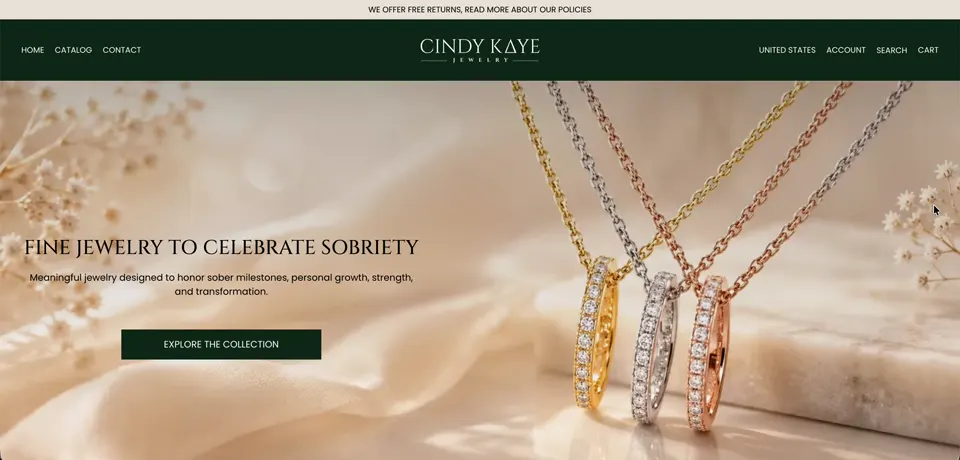
- Cindy Kaye Jewelry, moved from GoDaddy’s website builder to a custom Shopify build on Radiance, with redirects staged so search traffic carried over.
None of these seven fixes needs a new theme. Most stores we audit already have the photos, the specs and the policies. They’re just in the wrong place, or missing from the page where the buyer decides. If you’d like a second pair of eyes on yours, our jewelry Shopify work shows what we build for jewelry brands, and our Shopify CRO service starts with a free audit of your product pages.