Shopify Impressum and Widerrufsrecht Setup Guide for German Stores in 2026
What every German Shopify store needs for Impressum, Widerrufsrecht, PAngV pricing and TTDSG cookies in 2026, with the checklist we ship audits against.
A Clutch Verified Shopify agency
Rated 5.0 out of 5 stars by our clients
Key takeaways:
- Every German Shopify store needs a complete Impressum under § 5 TMG and a Widerrufsbelehrung under § 312g BGB before it takes a single euro.
- The 14-day Widerrufsrecht clock starts on delivery, not on order placement, and the Muster-Widerrufsformular is mandatory in the cancellation policy.
- PAngV requires the gross price (including 19% MwSt), shipping cost disclosure before checkout, and a Grundpreis for unit-measured goods.
- TTDSG cookie consent must be opt-in by default with a reject button as prominent as accept, not buried under a “Manage preferences” link.
- Trusted Shops Legal Texts, eRecht24 and IT-Recht Kanzlei pay for themselves within the first Abmahnung you avoid.
A Hamburg supplement brand received an Abmahnung two months after launch. Their Muster-Widerrufsformular was missing from the cancellation policy, the cookie banner defaulted every category to “on”, and the Impressum sat behind a link in the footer labelled “Legal Notice” rather than “Impressum”. A competitor’s lawyer noticed all three within ten minutes of opening the homepage. The cease-and-desist demanded a signed Unterlassungserklärung and 985 euros in legal costs, the founder paid it, fixed the store, and asked us to audit a second time so it would not happen again.
We run that audit on every German Shopify launch now. Below is the same checklist, the same statutes, and the same setup work we do for any DE-targeted store, whether the founder is in Berlin, Munich, Düsseldorf or selling cross-border from Vienna. If you want the same audit done on your store, our shopify development company in Germany page is the right starting point.
The two legal pages every German Shopify store must publish
Two pages are non-negotiable before a German Shopify store goes live: the Impressum and the Widerrufsbelehrung. Both are anchored in federal statute, both are enforceable by competitors through Abmahnung, and both are the single most common reason new stores get hit in the first quarter of trading.
The Impressum is required by § 5 of the Telemediengesetz (TMG). The Widerrufsbelehrung sits inside the consumer protection rules at § 312g of the Bürgerliches Gesetzbuch (BGB) with the procedural detail in the EGBGB. Together they are the legal “who we are” and “how you can return this” that every German consumer can demand to see before paying. Shopify does not generate either page for you. The store theme ships with empty placeholders. If you are launching a new German store, our Shopify store setup service runs the checklist below before go-live.
What § 5 TMG actually requires inside the Impressum
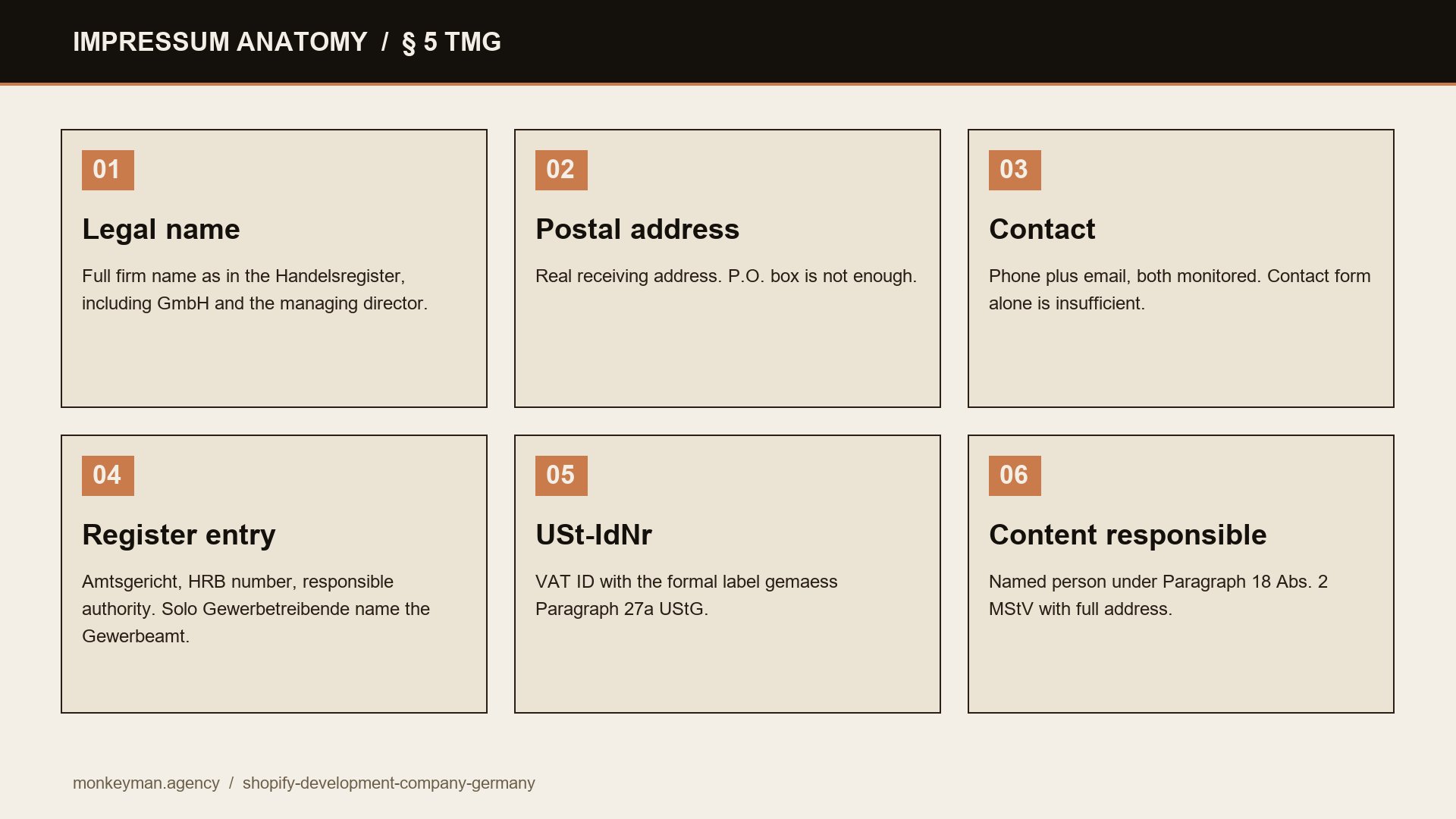
The statute is short but specific. A compliant Impressum names six things:
- The legal name of the operator, exactly as it appears in the Handelsregister or Gewerberegister. For a GmbH that means the full firm name including “GmbH” and the managing director.
- The full postal address. A P.O. box is not enough. A coworking address is fine if you actually receive mail there.
- Working contact details: a phone number plus an email address, both monitored. A contact form alone has been ruled insufficient by multiple Landgerichte.
- The register entry if applicable: Amtsgericht, HRB number, and the responsible authority. Solo Gewerbetreibende name the Gewerbeamt instead.
- The USt-IdNr (VAT identification number) if the business is registered for VAT, with the formal label “Umsatzsteuer-Identifikationsnummer gemäß § 27a UStG”.
- The person responsible for content under § 18 Abs. 2 MStV, named with full address. For most small stores this is the same person as the founder, but it must be named separately.
If the store sells regulated products (food supplements, cosmetics, medical devices) there are additional disclosure obligations under sector-specific law, including the responsible Behörde and any licence numbers. We add a row to the Impressum for each of these and we do not skip them.
Where the Impressum link belongs on a Shopify store
This is the rule that catches the most stores: the Impressum must be reachable from every page of the storefront, with no more than two clicks from any view, and the link must be labelled “Impressum” in German. “Legal Notice”, “Imprint” or “About us” do not satisfy the disclosure requirement for a German-language store. The Bundesgerichtshof has been clear on this since the early TMG cases.
In Shopify that means the footer menu under “Online Store > Navigation > Footer menu” needs a “Impressum” entry on every storefront page, plus inside the checkout footer, plus reachable from the cart drawer. We also drop the link into the order confirmation email template, because the same disclosure rule applies to transactional commerce communications.
The 14-day Widerrufsrecht and the wording it requires
German consumers have a statutory 14-day cooling-off period on distance contracts under § 312g BGB. The store must disclose this right in a Widerrufsbelehrung that follows the wording template in Anlage 1 to Art. 246a § 1 EGBGB. Drafting your own version is almost always a mistake. Competitors look for tiny deviations from the official template because the courts treat deviations as misleading.
Three details matter most:
The cooling-off clock starts at delivery, not at order placement. For a multi-package order the clock starts when the consumer receives the last package. For digital goods downloaded immediately the clock can be waived only with an explicit, separate consent step that Shopify’s stock checkout does not provide out of the box.
The Muster-Widerrufsformular (model cancellation form) must be included either inside the Widerrufsbelehrung or as a downloadable PDF linked from it. We embed it as a printable HTML block at the bottom of the Widerrufsbelehrung page, and we attach a PDF to the order confirmation email. Stores that omit the form are the easiest Abmahnung targets in the German market.
The consequences of cancellation, including the refund window (14 days from receipt of the cancellation notice) and who pays the return shipping, must be stated explicitly. If you want the customer to pay return shipping you must say so in the Widerrufsbelehrung itself, not in a separate returns page.
PAngV: how prices and shipping must be displayed
The Preisangabenverordnung (PAngV) governs every price the store shows. Three rules drive most of the audit work we do:
The displayed price must be the total price including 19% MwSt (or 7% for the reduced VAT categories like books and certain foods). Showing a net price with “plus VAT” in small text is not compliant on a B2C storefront. Shopify makes this straightforward in “Settings > Taxes and duties > European Union” by enabling “All prices include tax”. We turn that on for every German launch and verify the cart, checkout and email totals all match the storefront.
Shipping costs must be disclosed before the checkout step where they become payable, with a clear statement that they apply. We put a “zzgl. Versand” link next to the price on the product page, linking to the shipping cost table on a dedicated Versandkosten page, with the link visible without scrolling on mobile.
Goods sold by weight, volume or length need a Grundpreis (basic price per kg, litre, or metre) displayed alongside the unit price. For a 750ml bottle of olive oil that means “EUR 12.90 (EUR 17.20 / Liter)”. Shopify’s stock product templates do not render this automatically. We add a Liquid snippet that calculates and shows the Grundpreis for any product tagged with a unit measurement, and we tag every relevant SKU at migration time.
Trusted Shops, eRecht24 and IT-Recht Kanzlei: when each is worth it
Three legal-text services dominate the German Shopify market. We pick between them based on store stage and risk tolerance.
Trusted Shops Legal Texts costs roughly 9 to 19 euros a month and pairs with the Trusted Shops trustmark badge at 49 to 149 euros a month depending on tier. The badge converts. We have measured 4 to 7% conversion lift on supplement and skincare stores after adding the badge in the cart and checkout footer. The legal texts auto-update when the law changes, which is the part that matters more than the badge.
eRecht24 Premium runs around 27 euros a month and gives the same auto-updating Impressum, Widerrufsbelehrung, AGB and Datenschutzerklärung templates without the trustmark element. Good for stores that already have brand trust and just need the texts maintained.
IT-Recht Kanzlei sits at around 9 to 13 euros a month for the Premium template package and is the most lawyer-staffed of the three. They write more conservative texts and respond to template-specific Abmahnung incidents under the subscription. Good for higher-risk categories: supplements, cosmetics, age-restricted products.
For supplement, cosmetic and CBD stores we default to IT-Recht Kanzlei. For fashion and homewares we default to Trusted Shops because the badge is worth the conversion lift. For sub-100k-euro stores in low-risk categories eRecht24 is the cheapest acceptable answer. Drafting in-house is only worth it for in-house counsel teams.
TTDSG cookie consent: opt-in, equal weight, no dark patterns
Since the TTDSG came into force every storefront cookie or similar tracking technology that is not strictly necessary requires opt-in consent before it loads. Pre-checked boxes are not consent. Banners that present “Accept all” as a coloured button and “Reject” as a text link are now ruled non-compliant by multiple Datenschutzbehörden and have generated Abmahnungen of their own.
The compliant pattern is simple. The banner shows three buttons of equal visual weight: “Alle akzeptieren”, “Alle ablehnen” and “Einstellungen”. Until the visitor clicks one, nothing fires beyond strictly necessary cookies. Google Analytics, Meta Pixel, Klaviyo onsite tracking, Hotjar, Microsoft Clarity, TikTok Pixel, even Shopify’s own analytics in the EU context all require explicit consent.
Shopify’s built-in Customer Privacy API plus a consent management platform like Usercentrics, Cookiebot or Consentmanager handles this cleanly. We wire the CMP up so the consent state flows into Shopify’s analytics.privacy object and every tag fires through Shopify’s Customer Events with the correct consent gate. That stops the Meta Pixel from firing on a non-consented visitor, which is the most common cause of EU pixel rejection.
The German legal mistakes we see most often in audits
Patterns repeat. The six failures below account for the bulk of Abmahnung exposure we find:
The Muster-Widerrufsformular is missing entirely or hidden behind a download link the customer never clicks. The fix is embedding the form in the Widerrufsbelehrung page.
The USt-IdNr is listed without the formal “gemäß § 27a UStG” label. Tiny detail. But competitors check it.
The cooling-off clock is stated as starting at order placement rather than at delivery. We have seen this in every other German Shopify theme template we audit.
The cookie banner has pre-checked boxes or an “Accept all” button that visually dominates the “Reject” option. Easy Abmahnung.
The Grundpreis is missing on weight or volume-measured products. Common on supplement and cosmetics stores.
The Impressum link is in the footer but labelled “Legal” or “Imprint” instead of “Impressum”. Common on stores that translated an English template without adjusting the German legal labels.
The seven-step checklist we run on every German launch
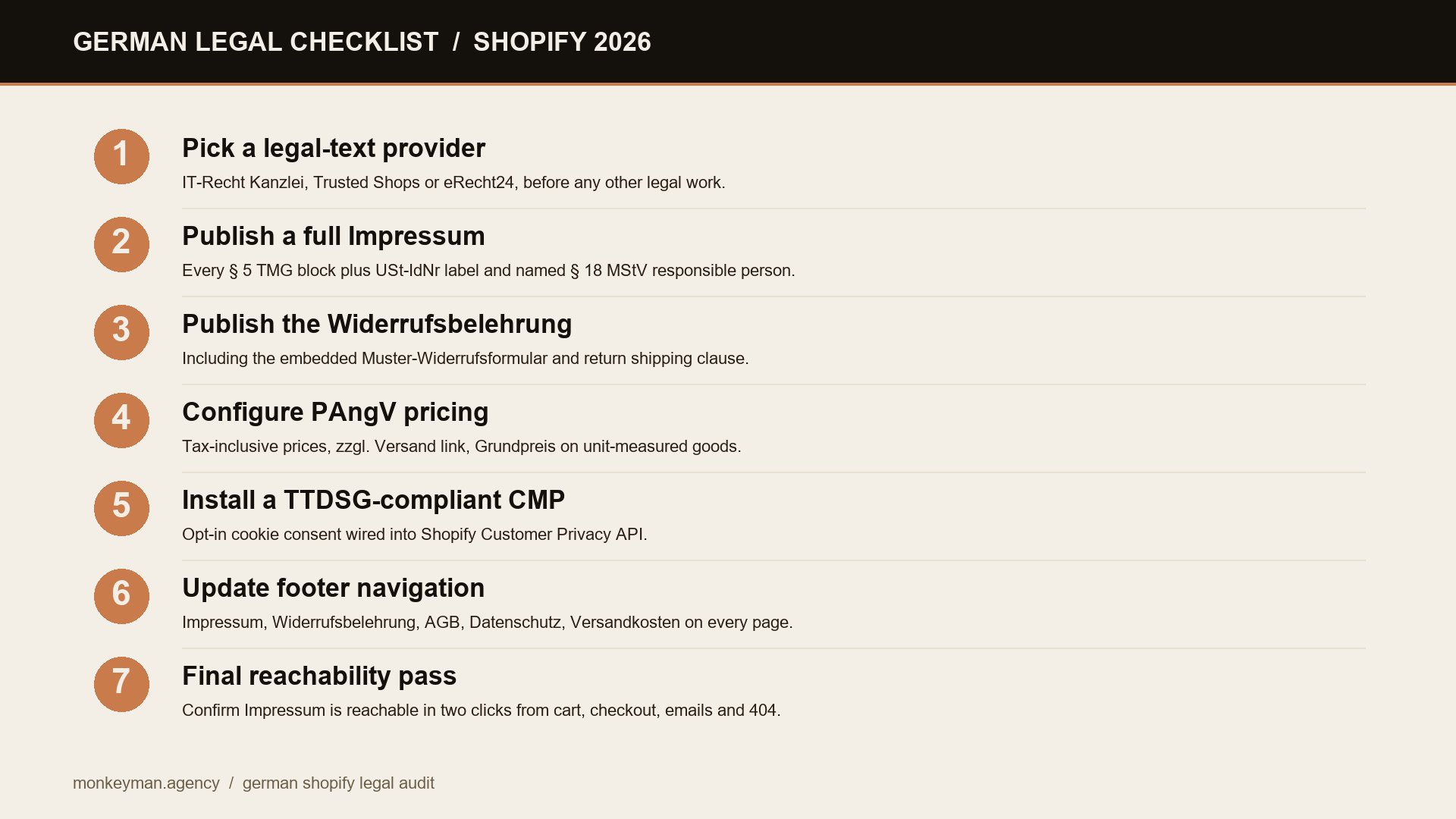
This is the same walkthrough we ship internally. It is sequenced so each step unblocks the next.
- Pick a legal-text provider (IT-Recht Kanzlei, Trusted Shops or eRecht24) and connect their auto-update plugin to the Shopify store. Do this before any other legal work, so subsequent updates do not get overwritten.
- Write the Impressum with every § 5 TMG block, including USt-IdNr with the formal label and the named § 18 MStV content responsible person. Publish at
/pages/impressum. - Publish the Widerrufsbelehrung with the embedded Muster-Widerrufsformular at
/pages/widerruf, plus the consequences-of-cancellation paragraph and the return shipping clause. - Turn on “All prices include tax” in Shopify tax settings, add the “zzgl. Versand” link on the product page, and add the Grundpreis Liquid snippet for unit-measured products.
- Install a TTDSG-compliant CMP (Usercentrics, Cookiebot or Consentmanager), wire it to Shopify’s Customer Privacy API, and verify no non-essential tag fires before consent.
- Update the Shopify navigation so the footer carries Impressum, Widerrufsbelehrung, AGB, Datenschutzerklärung and Versandkosten as separately labelled German entries on every storefront page.
- Run a final pass through the order confirmation email, the cart drawer, the checkout footer and the 404 page, confirming the Impressum link is reachable from each in two clicks or fewer.
After step seven we run the Shopify migration checklist audit once more, with German legal as a dedicated row, before flipping DNS. That last pass has caught at least one missing element on every store we have launched in the German market this year.
When to use a tool vs draft in-house
The honest answer is that drafting legal texts in-house pays off for two kinds of teams only: in-house counsel who already track Gesetzesänderungen, and very large multi-brand operators where licence economics flip against the per-store subscription model. For everyone else, paying 10 to 30 euros a month for auto-updated texts is the cheapest insurance available against a 600 to 2,000 euro Abmahnung.
We default to the subscription tools, layer the audit checklist on top, and treat the German legal stack as a recurring quarterly review rather than a one-off launch task. The law changes. The texts change with it. Stores that treat legal as a launch checkbox get hit twelve months later when the wording drifts.
The cheapest moment to fix any of this is before the first euro flows through the store. The second cheapest moment is now. If you want a second pair of eyes on a German-targeted Shopify store before the next Abmahnung notice arrives, send us the URL and we will run the seven-step audit and write back inside 48 hours.